Join over 5,000 readers of our monthly newsletter!


By submitting this form, you are consenting to receive marketing emails from: Bluejacket Shipcrafters, Inc.. You can revoke your consent to receive emails at any time by using the SafeUnsubscribe® link, found at the bottom of every email. Emails are serviced by Constant Contact

Blocks and Deadeyes

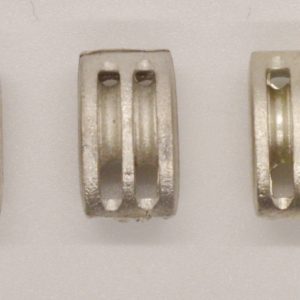
In the era of traditional sailing, blocks and deadeyes served as the fundamental mechanical components that allowed a crew to harness the immense power of the wind. A block – the nautical term for a pulley – consisted of a wooden shell containing one or more sheaves (wheels). By threading ropes through these blocks, sailors created mechanical advantage, allowing them to hoist heavy sails, adjust rigging, and manage loads that would otherwise be impossible to move by hand. Essentially, blocks acted as the force multipliers of the ship, simplifying the complex labor required to navigate and trim the vessel.

Complementing the block’s role in movement was the deadeye, a sturdy, circular wooden block pierced with three holes, used primarily to secure and tension the ship’s standing rigging. Unlike a pulley, a deadeye was stationary; it functioned as part of a “lanyard” system, where a rope was threaded back and forth through the holes of two connected deadeyes to pull shrouds or stays taut. This setup acted as a heavy-duty turnbuckle, providing the immense tension necessary to stabilize a ship’s masts against the leverage of the wind. Together, these simple but ingenious wooden tools formed the backbone of a ship’s rigging, providing the structural integrity and kinetic control essential for traversing the open ocean.

Join over 5,000 readers of our monthly newsletter!


By submitting this form, you are consenting to receive marketing emails from: Bluejacket Shipcrafters, Inc.. You can revoke your consent to receive emails at any time by using the SafeUnsubscribe® link, found at the bottom of every email. Emails are serviced by Constant Contact